
Book Review: For the Eternal Glory of Rome
In which Tom Kratman, level-headed right-winger and master of military science fiction, tackles the time-travel genre.

Over the last few years, I’ve reviewed a handful of right-leaning novels at Twilight Patriot. Some of these, like the books in C.S. Lewis’ Space Trilogy, were written a long time ago. But others, like Richard Nichols’ spy novel Lost Causes, are recent works whose authors ran across my substack and were kind enough to send me free copies to review. Thanks to Alexander Macris, a tabletop game designer who writes the Substack Contemplations on the Tree of Woe, I am now reviewing another book of the latter sort. A few months ago Macris introduced me to Tom Kratman, who then sent me an early review copy of his upcoming time travel story For the Eternal Glory of Rome, which is scheduled for release on 6 January (4 days from now) and is currently available for preorder at Baen Books.
Kratman is a fascinating character who already has decades of novel-writing experience behind him. But in the beginning, he was a soldier, as explained on his website:
Tom Kratman is a political refugee and defector from the People’s Republic of Massachusetts. The mechanism of his defection was enlisting into the Army in 1974 at age 17, which deeply distressed his high school (Boston Latin, founded 1635) as they thought he had “higher and better things” ahead of him...
Kratman’s lengthy Army career included deployments to Panama and Iraq, combat as an infantry officer during the First Gulf War, a transfer to the Reserves so he could attend law school, a few years practicing law, and a stint on the faculty of the Army War College. He retired at the rank of Lieutenant Colonel in 2006, and to his great pleasure, his second career as a writer for Baen Books took off quickly enough that he didn’t have to practice law again.
Since then, Kratman has written or co-written twenty novels for Baen Books, a publishing house founded in 1983 by Jim Baen who, like Kratman, was an ex-soldier and a big proponent of military science fiction written by military men.
Kratman is solidly committed to writing war stories, but within that genre his works are extremely diverse. His excellent novella Big Boys Don’t Cry, which was nominated for the Hugo Award in 2015, is told from the point of view of a Ratha, one of the sentient tank-like war machines that fight mankind’s battles across hundreds of planets in the 30th century. His most ambitious work is the eight-book series that begins with A Desert Called Peace, which is set in the 25th century on a colony planet called Terra Nova, and deals with a man whose vendetta against the slayers of his family drives him to become the most brilliant and ruthless mercenary commander in a war that parallels recent events in the Middle East.
A different kind of future shows up in Caliphate, a 2008 novel set in the early 22nd century, where the United States has transformed into an autocratic empire that rules all of North and South America, plus England and the Philippines. (And it managed to do this without repealing the old constitution, since technically it’s not illegal for the president to just pardon the assassins of his political enemies.)
Yet for many people who live in the rest of the world, America is still a beacon of hope, and a country worth risking everything to flee to, because the situation at home is so much worse. We learn this at the very beginning of the book when we meet Petra, a German girl who lives the humiliating life of a Christian dhimmi under an Islamic caliphate. When her family can’t pay the jizya tax, Petra and her brother are both sold into slavery, and at age twelve – which is a legal age for such things – Petra is put to work in a brothel. (Since this is a work of military science fiction, it goes without saying that the two civilizations will collide in a way that involves lots of bodies hitting the ground.)
Caliphate, whose cover blurb features the phrase “demography is destiny,” seems to have gotten the most attention out of all of Kratman’s books because it annoyed all the right people. Of course the charge that he paints Muslims with a broad brush isn’t true – there are several sympathetic Muslim characters in the story, who are horrified by the uglier aspects of the system they live under. But one of the things about long wars is that they tend to leave a society’s worst people in charge, as we saw in Russia after World War I, or a few years ago in Afghanistan. Most Afghans have little or no enthusiasm for what the Taliban does, just like most Russians weren’t Bolsheviks, but when a society is sufficiently war-weary, the people who are best at organizing and justifying violence will end up on top.
One of the draws of Tom Kratman’s work is that, beyond the mere technical mastery with which he approaches logistics, battlefield tactics, weapon technologies, and the other sides of military life, he’s also willing to take a hard look at the aspects of history and human nature that wokesters would prefer we all forgot about. And this is just as true in his newest project, For the Eternal Glory of Rome.
This novel begins in the year AD 9, during the reign of Octavian Augustus, just as Rome’s 17th, 18th, and 19th Legions are being annihilated by thirty thousand Germans in the Battle of the Teutoburger Forest. This real-life battle put an end to Rome’s expansion into northern Europe, with later emperors, from Tiberius onward, being content to keep the frontier at the Rhine, where it stayed until the barbarians finally breached it in AD 406.
The architect of the three legions’ downfall was Arminius, a Cherusci German chieftain who had gained military experience fighting for Rome in the Balkans, then decided that he had seen enough of the Roman empire that he would do anything to stop it from expanding into his homeland. With the Roman commander, Publius Quinctilius Varus, still thinking Arminius was loyal, he lured the legions into an ambush in northern Germany, where he had persuaded several Germanic tribes to lay aside their previous quarrels and unite against the Romans. Varus’s casualties were almost total. The three legions’ eagles were captured, very few Romans survived, and Arminius himself was later described by Tacitus in the following terms:
Assuredly he was the deliverer of Germany, one too who had defied Rome, not in her early rise, as other kings and generals, but in the height of her empire’s glory, had fought, indeed, indecisive battles, yet in war remained unconquered. He completed thirty-seven years of life, twelve years of power, and he is still a theme of song among barbarous nations, though to Greek historians, who admire only their own achievements, he is unknown, and to Romans not as famous as he should be, while we extol the past and are indifferent to our own times. (Annales 2:88)
Now for Tom Kratman’s twist on the story. In this version, the doomed Legio XIIX (or XVIII, the Roman numerals weren’t quite standardized yet) attracts the pity of a passing alien spaceship, whose two occupants use their arts of teleportation to pick up all six thousand men, and much of their equipment, and drop them near the Oxus River nearly four centuries into the future. The men who are saved this way (though it takes them a while to find out where and especially when they reappeared) obviously think that the Gods have done it (or, for the legion’s Jewish medicus, that God did it), probably for some great purpose. But Kratman himself gives us a thoroughly comic account from the space traveller’ point of view, with lines like:
“I wish I could take them out while leaving their exoskeletons behind,” Red muttered. “The power drain is going to be enormous.”
“I don’t think they’d long survive that,” trilled Blossom, in sweet notes and sharp whistles, ending with a distinct click….
“Maybe they shed their exoskeletons at certain points in their lives. You know there are plenty of insects who do. I’d still bet it’s painful enough to kill them if they’re not naturally ready”…
“I am – reluctantly – taking their beasts and conveyances. The trees would be just too much. I’m also not going to try to send any of their exoskeletons that are lying around.”
“But what if they need to eat them to help them grow another? Please send those, too. And the upright plant life? They may need those to live. Please send some at least.”
“Oh, all right. Though what insect eats metal, I do not know…”
To no one’s surprise, the legionaries do end up needing their “exoskeletons.”
Some of my readers may be familiar with a few of the major works in what I might as well call the “corporate time travel” genre. These are stories in which a community of hundreds or thousands of people are plucked out of their normal lives by a mysterious force, and dropped into a different era where they have to use all their wits to survive – novels like Eric Flint’s 1632 series (a mining town from West Virginia ends up in Germany in 1632 and is soon calling the shots in the Thirty Years’ War) and S. M. Stirling’s Island in the Sea of Time (Nantucket Island and a passing tall ship are teleported into 1250 BC). I read both those books as a child and enjoyed them, in large part for their technology/engineering side – what could people with today’s knowledge, but without today’s resources, do to get the food, weapons, etc. that they need?
But those novels’ heroes have it easy compared to Kratman’s legionaries, who are sent into their own future. At first, they have no edge on anyone else except for their attitude. They know how to work and fight as a legion, and they know what peak Roman power and competence look like. And that’s about it.
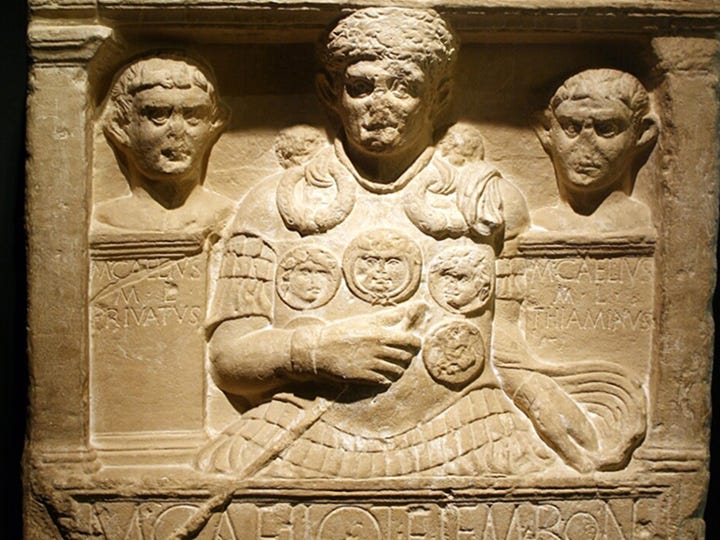
The story has two lead characters: The high-born Gaius Pompeius Proculus, the legion’s 22-year-old junior tribune, and Marcus Caelius, the 53-year-old primus pilus or first spear centurion – the leader of 59 other centurions, and in modern terms the senior NCO of Legio XIIX. I discovered after reading the book that Kratman had chosen these men as his protagonists because they are among the few real-life members of the legion whose names are known; archaeologists have found monuments erected to each of them after news arrived of their deaths in Germany.
In Eternal Glory of Rome, Gaius Pompeius is the only surviving tribune and, notwithstanding his youth, the new commander of Legio XIIX. Despite his understandable moments of self-doubt, he proves to be an able leader largely due to the advice of the gruff, solid, and experienced Marcus Caelius, who becomes like a father to him in the following years, as the Eighteenth Legion finds its bearings and fights its way back from the Asian steppe to Roman Gaul.
At first the book can seem rather slow. This, I think, is deliberate – Kratman wants to show us just how the legionaries build their camps (everything from a one-night marching camp to a heavily-fortified overwinter camp), how they build everything from outhouses to wagons to bridges, how they treat the wounded (whether man or beast), and how they promote and demote officers, reward valor and administer punishments, scout out strange landscapes, trade or fight with natives, and look after the legion’s complement of livestock and slaves. And of course how they use their swords, shields, and other weapons in battle – there are plenty of battles. Nor does the author shy away from the darker sides of Roman life – among other things, Legio XIIX owns several wagonloads of public prostitutes; these women are state property that each well-behaved soldier is entitled to use each time his rotation comes up.
It takes a few years out on the steppe for Gaius Pompeius and Marcus Caelius to build their legion into the lethal fighting force (and engineering and political force) that we see by the end of the book. And when its ten-thousand or so men and women (the legion has been swollen quite a bit with auxiliaries) ride their captured Scythian ponies all the way back across the central European plain to the Rhine where they started, they meet a Roman Empire that desperately needs them.
The legions they run into are small – barely a thousand men each, many of them barbarian mercenaries – poorly equipped, and poorly trained, no longer able to put up a proper bridge or castrum, and reliant for supplies and orders on a government rendered impotent by infighting and graft.
“In what way,” asked Marcus Caelius, “is the Empire even Roman? Everyone who isn’t a slave is a citizen, while being a citizen means just about nothing. Like citizenship, the money is mostly worthless.” Caelius barked a bitter laugh. “Why, we may be sitting on more actual cash than the Empire can come up with. Even both halves of it – did you hear me say that? ‘Halves!’ – of it. The old religion is gone, replaced by this newfangled superstition out of Judea. And Rome, our Rome, isn’t even the capital anymore.”
The men of Legio XIIX have known to expect a disastrous future ever since Appius Calvus, the legion’s haruspex, awoke. Alone out of all the men, his spirit was temporarily separated from his body after the time-travel, and he wandered far into the future, seeing such scenes as cattle being stabled in Rome’s senate house, Rudyard Kipling poring over the volumes of Gibbon’s Decline and Fall of the Roman Empire, and Johannes Gutenburg at work on his printing press in Mainz. (Calvus remembers enough about the printing press to build one when the legion makes it home, providing Kratman’s heroes with their sole anachronistic invention.)
By the time I had finished this book, I ended up liking it more than I thought I would.
One of my complaints was fairly minor – Kratman’s legionaries don’t curse creatively enough. They use “Hades” in the exact same places an American soldier would say “Hell,” and they have the same collection of idioms involving the word “ass” – which for me always brought to mind a literal donkey, since that’s the only thing that that word meant to Latin-speakers. (In case you’re wondering, there are scholarly articles about how Roman profanity actually worked.) Also, the ease with which the survivors of a certain massacre came to fight loyally alongside the slaughterers of their fathers and brothers was jarring – perhaps believable in a world where what we call a “war crime” is simply how war is always fought, but perhaps not; blood feuds were a serious business back then, too.
But a more serious hangup was simply that I tend to dislike alternate history stories. I think that by portraying history as a series of accidents (“Look how differently things would have turned out if Barton Mitchell hadn’t found the Lost Order, or if the Axis had gotten the atom bomb first!”) it encourages people to overlook the very deep roots of the big events in history, events which are usually overdetermined.
For instance, it’s easy to argue that Western Civilization would be in a better condition today if Napoleon had won at Waterloo, and at whatever follow-up battles he needed to fight in order to hold onto his throne. But Napoleon already was victorious in all but ten of his eighty or so battles; his empire fell anyway because, though he didn’t quite start any wars, he responded to every provocation by escalating, often to the point of getting bogged down in unnecessary campaigns deep in enemy territory (Spain, Russia, etc.) While it’s easy to imagine a version of Napoleon who was less impulsive and more aware of his limitations, that person could never have come to power in the cutthroat political environment of the French Revolution. And so forth.
(Edmund Burke had predicted, scarcely a year into the Revolution, that the chaos would only end when “some popular general, who understands the art of conciliating the soldiery, and who possesses the true spirit of command... [becomes] the master of your whole republic.” Burke was almost certainly thinking of the Marquis de La Fayette. When La Fayette proved unwilling to seize power in this way, a different “popular general” filled the gap. Great men matter, but only when the broader currents of history make room for them.)
Hence my perspective on the Fall of Rome: It was inevitable, due to hundreds of years of decadence and decline. The Visigoths and Vandals and other Germanic barbarians who checked and eventually reversed Rome’s expansion are the heroes of the story – along with the Parthians, Armenians, Kushites, Irish, etc. who blunted Roman aggression along other frontiers. And the medieval Christian civilization that those Germans built on the ruins of Rome was superior to it in many ways, as I’ve written about before.
And yet, Tom Kratman managed to get me to sympathize with the returning legionaries anyway. It’s one thing to ask what little thing would have had to go differently for a losing cause to be a winning one. It’s another thing to ask what would happen if an army division’s worth of men from the peak of a civilization – bringing their skills, their virility, their discipline, and their can-do attitude – were put face to face with the kind of men who appear during a civilization’s fall, men like the emperor Honorius.
“What happens if you don’t get on your belly for this boy called an ‘emperor’?...
“I don’t know,” [Marcus Caelius] admitted. “Stilicho said it’s never happened before, not in the last century.” Caelius sneered. “These people who call themselves Romans are just circus freaks, performing dogs, parading around wearing the flayed skin of Rome. Yes, sure, we lived under a dictatorship under Augustus, but he kept the forms, he kept the law, and he made us feel like we were all citizens of a republic. This lot are just slaves.”
“Tell me, man who is my husband in all but name, could you restore this thing you call a ‘republic’? Could you and all your allies and the Eighteenth Legion together restore it?”
Regretfully, Caelius shook his head. “No, things are too far gone. There’s hardly a man alive, worthy of the name, outside of the legion who even knows what a republic is, not really….”
But are things really too far gone?
In a world without time travel, we know what the answer would be. But after the finale of Kratman’s book – in which (to my relief) the Vandals and Alans and Suebi are presented in a fairly sympathetic light, and the legionaries learn from experience to question some sides of their own culture’s morality – I am eager to see what this author has in mind for the sequels. (Kratman told me that what he is planning is “probably a trilogy. Note, however, that a Baen ‘trilogy’ is five books, except when it’s more than that.”)
For anyone who’s into adventure stories, or who is fond of getting into the details of Roman camp-building, weapons, armor, and tactics, or who simply likes to ponder the age-old question of why civilizations decline and fall, For the Eternal Glory of Rome is worth a read.